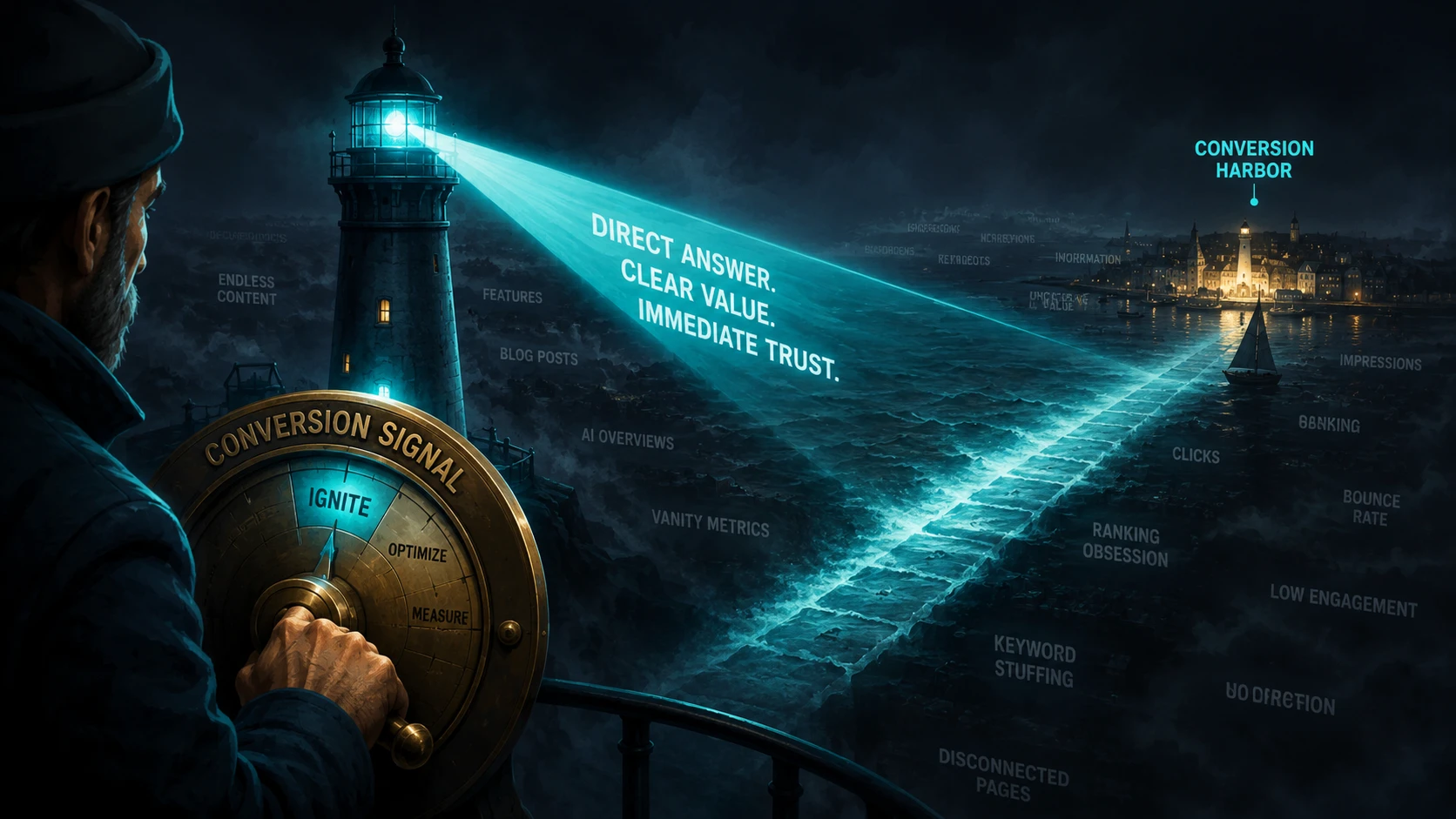
In the history of navigation, the most critical moment was the approach to the home port. After weeks of charting unknown seas and relying on the Navigator’s Logbook, the success of the entire expedition rested on a single, clear signal from the lighthouse. In the digital journey of 2026, that signal is your Call to Action (CTA). [1]
As we established in our foundational guide to conversion, visibility is only the first half of the battle. To turn a prospect into a client, you must provide a Direct Directive. This is the moment where you move beyond information and enter the realm of instruction. In an era of Intelligent Search Interfaces, your directive must be so clear that even a machine feels safe recommending it as the final destination for the user.
Key takeaway: A Call to Action is not an invitation; it is a directive that solves the user’s problem by showing them the exact door to the solution.

The Psychology of the Command
Professional advertising masters like John Caples and David Ogilvy spent decades testing how to get people to act. Their most consistent finding was simple: people want to be told what to do if they trust the person speaking. In 2026, this is known as the Authority-Action Loop. [2]
When a user reaches the end of your Slippery Slide, they have already absorbed your proof and your data. If you then offer a weak suggestion like “Learn More,” you are introducing new friction. You are forcing them to think again.
A Direct Directive removes this mental load. [3] It uses active, self-interested verbs that promise an end-result.
- Passive: “Contact us for more info.”
- Direct: “Get Your Custom AI Strategy Session.”
By using these “Command Sentences,” you provide the Intelligent Search Interface with a clear summary of your business’s value proposition. When the AI tells a user, “You can secure your brand’s future by booking an audit with Bittbuzz,” it is simply repeating the directive you have engineered.
Engineering the “Harbor Gate” (Technical CTA Visibility)
In the age of Generative Engine Optimization (GEO), your CTA is not just a button for humans; it is a data point for machines. AI search tools look for “Actionable Entities.” If your website clearly identifies its booking process using the correct technical labels, the AI records your business as a high-intent destination.
As we detailed in our guide to technical website organization, using PotentialAction and OrderAction labels in your code is essential. This tells the search bot: “This is where the user completes their goal.”
When your technical labels match your written directive, you create Entity Trust. [4] The AI feels “safe” providing your link as the final answer because it can verify exactly where that link leads and what the user will achieve there. This is the ultimate goal of the shift from clicks to direct answers.

Eliminating Choice Paralysis: One Course, One Port
One of the most dangerous reefs in the conversion journey is the “Multi-CTA” page. If your service page asks the user to “Follow us on Twitter,” “Sign up for a Newsletter,” AND “Book a Call,” you are creating choice paralysis.
In a storm, a captain doesn’t want three different sets of instructions; they want the one path that leads to safety. To maximize bookings, you must enforce the Rule of One:
- One Primary Goal: Every page must be built to drive a single specific action.
- One Primary Message: Your directive must repeat the core benefit found in your headlines.
- One Primary Path: All secondary links should be subordinate to the main booking button.
By narrowing the focus, you increase the “Linguistic Weight” of your directive. [5] This makes it easier for an AI to summarize your offer, leading to a higher “Citation Share” in the final recommendation lists provided by Intelligent Search Interfaces.
| Directive Type | Human Perception | AI Classification |
|---|---|---|
| ”Contact Us” | Vague, high-effort | Low-intent information |
| ”Learn More” | Educational, low-urgency | Middle-of-funnel resource |
| ”Book Your Audit” | Decisive, benefit-driven | High-intent transaction |
| ”Get the Guide” | Helpful, low-risk | Justification asset source |

Conclusion: Arrival at the Home Port
The journey of your digital growth ends here. By mastering the art of the Direct Directive, you close the gap between being “found” and being “hired.” You become more than just a source of information; you become the pilot who guides the customer to their final destination.
In the AI-driven world of 2026, the businesses that win are those that provide the most certain path. By combining the psychological wisdom of the masters with the technical precision of modern search, Bittbuzz ensures that your brand is the only logical choice for your prospects. Your visibility is the lighthouse; your directive is the open harbor.
Immediate steps for your Direct Directives:
- Audit your top 3 pages: Replace every “Contact Us” with a specific, benefit-driven command.
- Ensure your primary CTA button is the most visually distinct element on the mobile screen.
- Verify that your JSON-LD labels correctly identify your primary booking actions.
To continue your journey toward total domain dominance, we recommend a final review of our complete guide to modern search.