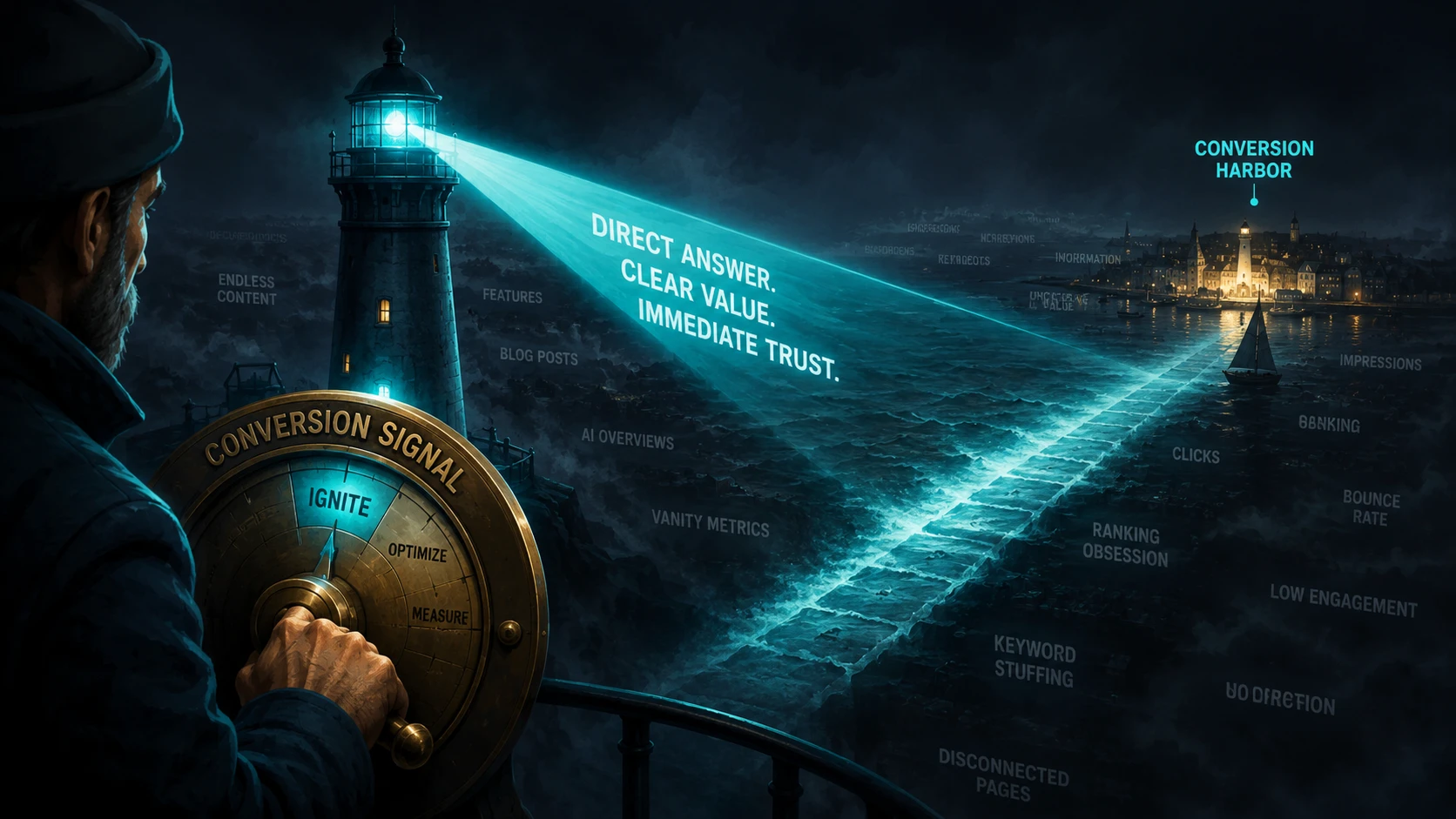
Short answer: a justification web is not a format or a scoring system — it is the discipline of attaching a checkable fact to every claim you make. Specificity is what makes a claim verifiable, and verifiability is what survives being summarised by an assistant or read on a phone by someone comparing you against two competitors.

Why vague claims fail everyone
Three problems are usually blamed on AI, and none of them are AI.
The first is that vague claims are unfalsifiable. “Best plumber in town”, “leading digital agency”, “years of experience” — these cannot be checked, so a reader has nothing to evaluate. They are not persuasive; they are simply inert. A reader who cannot tell whether a claim is true learns nothing from it, which is the same as learning it is decorative.
The second is that repetition is easy and specificity is not. Anyone can add adjectives. Saying exactly how long you take, how many jobs you did, and what happens next requires knowing, and deciding to be accountable for the number.
The third is that AI assistants have made the cost of vagueness higher, and this part is real. When someone asks an assistant for a recommendation, the answer is usually a short summary built from a handful of sources. A page that says “trusted by hundreds of clients” summarises to something equally empty, or gets dropped in favour of a page that states something concrete. This is not a ranking mechanism or a citation trick. It is also the reason the entity work described in automated entities matters here: an unambiguous business is easier to write a checkable claim about, and entity consistency is what keeps that claim true as the business changes. [2] It is compression: detail is what survives being compressed, and adjectives are the first thing lost.

Four kinds of proof, ranked by how much they are worth
Most sites have plenty of one kind and almost none of the others. It helps to know which is which.
| Proof type | Example | How easily a reader can check it |
|---|---|---|
| Statistic you can source | ”340 boiler installs in this county since 2019” | Easy — it names a scope and a period |
| Described process | ”The survey email arrives the same morning, before we quote” | Easy — they will find out within a day |
| Review quoting the same problem | ”Came out same day when the heating failed” | Easy — it names a situation like theirs |
| Superlative | ”The leading installer in the region” | Not at all |
The bottom row is not worthless, but it cannot carry an argument. If your service page is built from the bottom row, the fix is not to add more of it — that is the usual instinct and it makes the page worse. The fix is to find the three or four claims a customer would actually use to choose, and go and get real evidence for each.
Key takeaway: the strongest proof is a number with a stated scope and period, because anyone can check it and being checkable is what makes it persuasive.
The one rule that prevents most of this from going wrong
Do not publish a figure you cannot source.
This is worth stating plainly because the temptation is strong and the consequences are asymmetric. A real number that is unflattering is still useful, and it is still true. An invented one is a liability that compounds: if a customer notices, every other claim on the page becomes suspect, and you will not get a second impression from that visitor. Google also targets pages whose content is scaled or generated without regard to accuracy, so fabricated precision is not a neutral risk.
If you genuinely do not know a number, describe the process instead. “The survey email arrives the same morning, before we quote” carries almost as much weight as a percentage, because the reader knows within a day whether it is true. That is measurable, which makes it more credible than a statistic — not less.

Attaching dates, because claims rot quietly
Most stale claims are not obviously stale. A page saying “same-day service” is true until the moment you hire someone and cannot cover the mornings; nobody goes back to check it. Prices drift. Coverage areas change. The person whose experience is being described leaves.
So a justification web needs dates, which are unglamorous and completely effective:
- Put a review year or month on anything you quote as recent.
- Date the facts most likely to change — prices, hours, coverage, response times.
- Re-read service pages on a schedule rather than on a trigger. Nobody notices a page decaying; everyone notices after it has.
Google’s guidance is to make substantive changes rather than cosmetic ones, and a date stamp with no change behind it is exactly the cosmetic update it warns against. If you update a page, change something a reader would notice. If nothing has changed, leave it alone rather than touching it to look fresh. The related argument about what to do with pages that have genuinely decayed is covered in pruning for scale.
Reviews are the easiest source of dated, specific proof. [4], and they are the one most local businesses already have without realising it. Getting reviews onto your profiles covers the mechanics; Google’s own guidance on soliciting them is worth reading before you write the request, because how you ask affects how people respond.
Keep proof next to the claim
Visitors do not read proof pages; they read the page they arrived on, and they scan rather than reading linearly. [3] A testimonial section on a separate page, linked from nowhere, is doing no work. A review quoted directly beneath the sentence it supports is doing a great deal.
This is partly about attention and partly about compression. If a page makes its case in one place, a human skimming it gets the argument, and anything summarising the page gets a claim with its evidence attached rather than a claim floating on its own. Google’s helpful-content guidance is really about whether a page is genuinely useful [1] to someone arriving with a real question, and putting the proof next to the claim is the clearest version of that.
The practical version of this is the content audit: read each service page and, for every claim, write down where the evidence is. If you cannot point at it in a sentence, either find the evidence or delete the claim. Most pages lose a third of their words to this exercise and get better for it. Ahrefs publishes a process for running one if you want the template. [5]

What to do first
- Open your three most important service pages. For each claim, note the evidence beside it, or delete it.
- Replace one superlative with a fact you can source and date. One is enough to establish the pattern.
- Pull two reviews that describe the same problem the customer arrived with, and quote them under the relevant claim.
- Set a recurring reminder to re-read service pages every few months. Decay is invisible from inside.
A justification web is not a project. It is what your pages look like once you have stopped writing claims nobody can check — and for most local service businesses, that is a few hours of honest rewriting rather than a new budget.
How this connects
- Capture and book covers what happens once a visitor is on the site and deciding.
- Clicks versus direct answers covers why being quoted is now a goal in its own right.
- Schema and structured data covers marking up the facts so they are unambiguous.
- Original data covers where to get evidence you do not currently have.