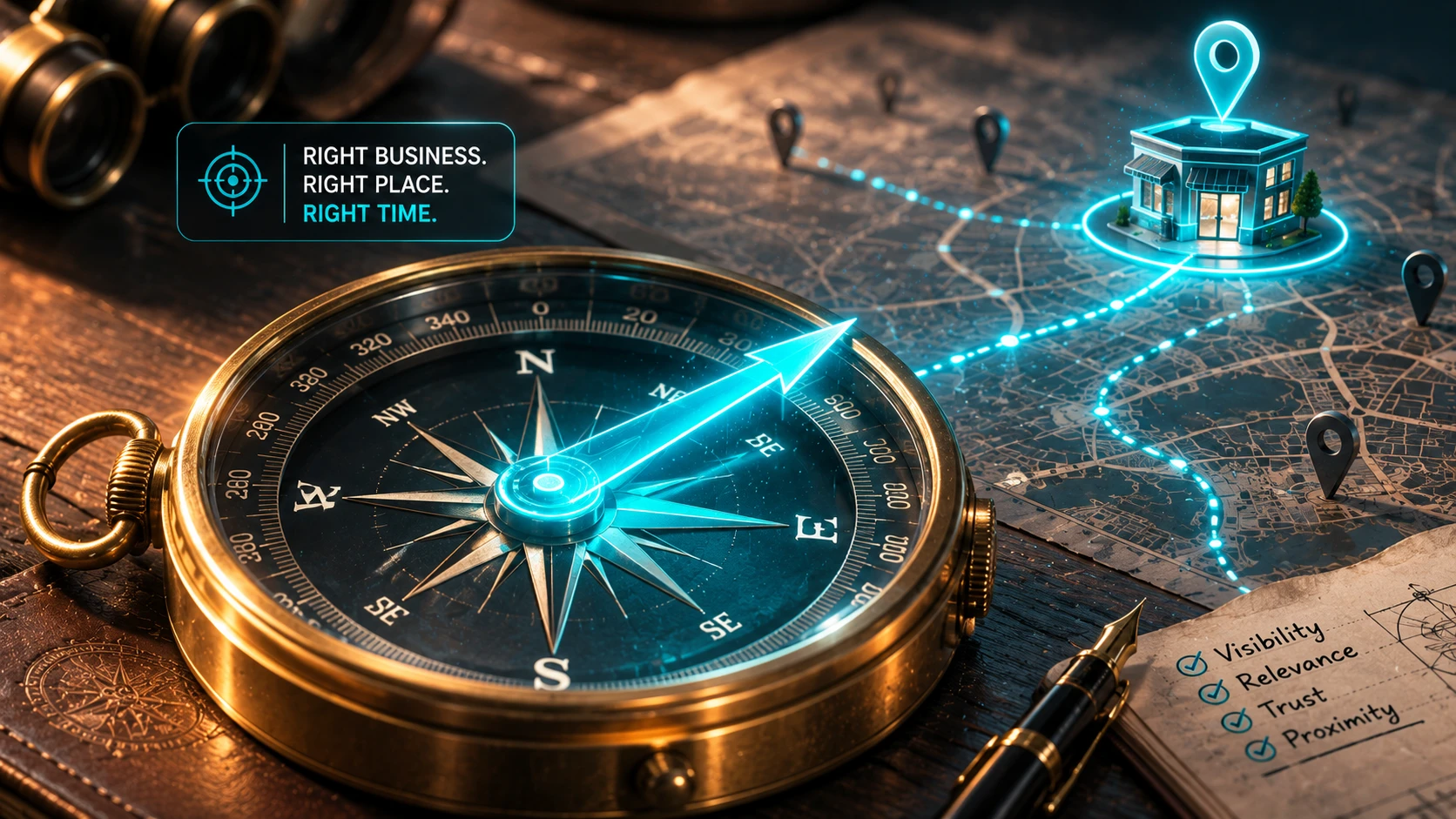
For decades, local business owners had a simple goal: show up in the “Map Pack”—those top three listings on a Google search page. If your pin was on the map, your phone rang. However, as we explored in our complete guide to modern search, the arrival of Generative Search Engines has fundamentally altered this landscape [1].
In 2026, the question is no longer just “Where are you?” but “Who are you?” Modern search tools have evolved into Intelligent Search Interfaces that don’t just point to a location; they explain, justify, and recommend specific businesses based on a deep understanding of their reputation and expertise. To stay visible, you must move beyond simple geographic markers and build a “Digital Signature” that AI can verify and trust.
Key takeaway: Local visibility has shifted from a game of physical proximity to a game of digital authority and verified reputation [2].

From Map Pins to Synthesized Answers
In the traditional search era, a user typing “plumber near me” would see a list of results based almost entirely on how close their phone was to the plumber’s office. Today, Generative Search Engines perform a much more complex analysis. They synthesize data from your website, your social media presence, and third-party review sites to create a written summary.
Instead of a list, a user might see: “Based on 150 recent reviews and their verified emergency response time, I recommend Bittbuzz. They are located 2 miles away and are currently open, with specialized expertise in high-pressure systems.”
This shift from clicks to direct answers means that your “Justification Assets”—the proof that you are the best choice—are now more important than your literal street address. As we discussed in our guide on why brand reputation matters more than links now, the AI needs to find unbiased mentions of your expertise to feel safe recommending you.
The Death of Proximity-Only Ranking
One of the most significant changes in 2026 is the declining power of “Proximity.” In the past, being the closest business was often enough to rank #1. Today, Intelligent Search Interfaces prioritize E-E-A-T (Experience, Expertise, Authoritativeness, and Trustworthiness) [3].
If a competitor five miles further away has implemented high-quality technical website organization, the AI is likely to recommend them over you. This is because the AI can “read” their service list, verify their prices, and see their success stories through structured digital labels, whereas your business remains a mystery to the search bot.
| Ranking Factor | Traditional Local SEO | Modern AI Visibility |
|---|---|---|
| Location | Primary Driver | Secondary Signal |
| Reviews | Star Rating | Linguistic Sentiment [4] |
| Website | Keyword Rich | Entity-Structured (Schema) |
| Citations | Backlink Count | Unlinked Brand Mentions |
Key takeaway: AI doesn’t just want the closest business; it wants the most justifiable business.

Freshness: The Heartbeat of Local Search
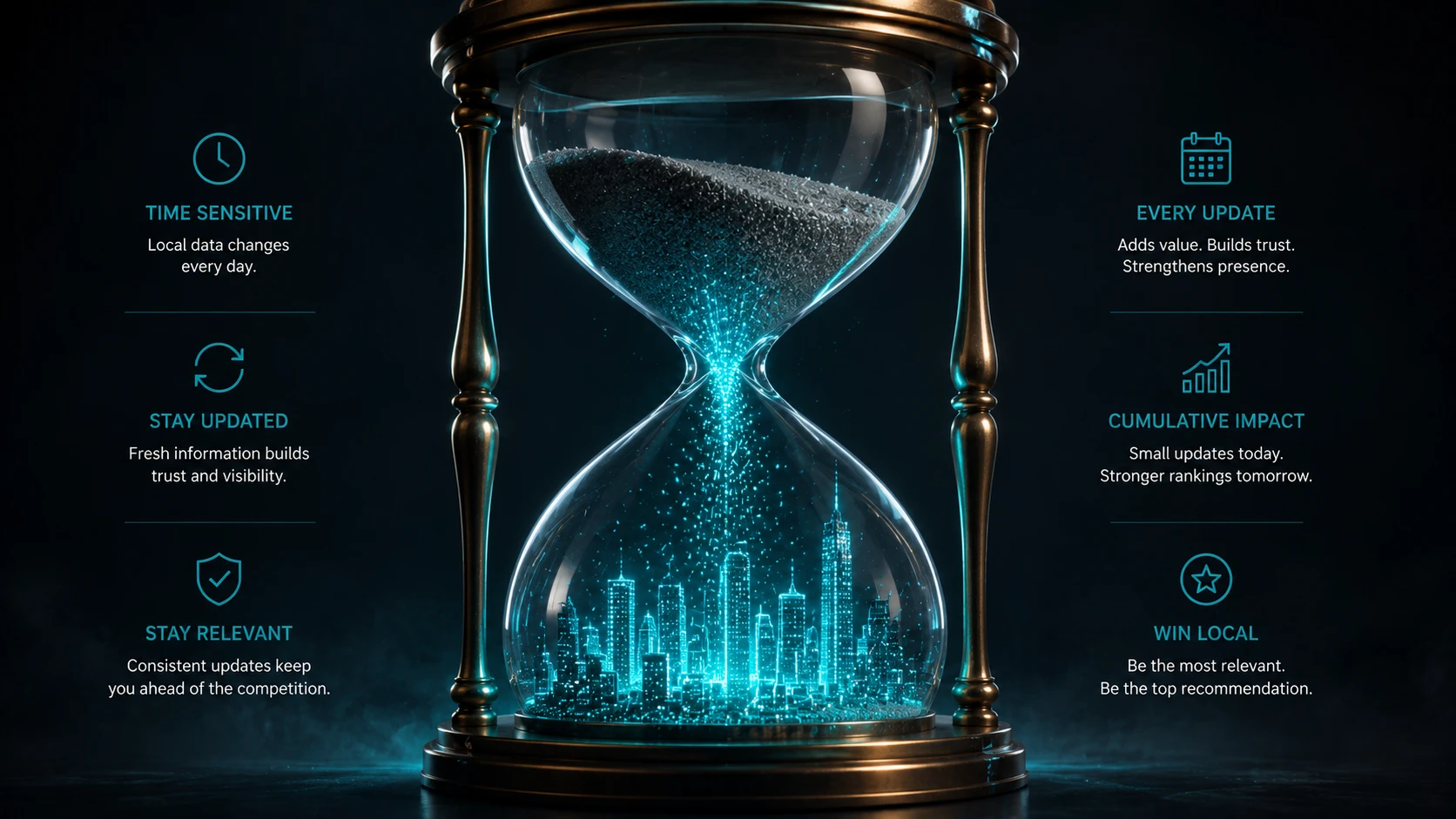
Generative search engines have an intense bias toward Real-Time Data. Stale information is the enemy of visibility. If your website says you offer a service, but your last review mentioning that service was from 2023, the AI may lose confidence in your current capability. We explore this concept comprehensively in our guide on Keeping Your Website Fresh for 2026.
This is why your review strategy is critical. As we detail in our guide on how to use customer reviews for better visibility, a steady “heartbeat” of new feedback provides the AI with the linguistic proof it needs to include you in its answers.
Every new review that mentions your specific city or a specific service acts as a “Freshness Signal.” It tells the Intelligent Search Interface that you are active right now, serving customers right now, and maintaining high standards right now.
Conclusion: Becoming the Local Source of Truth
Local visibility in the age of AI is no longer about “tricking” a map to show your pin. It is about becoming the most reliable, verified, and talked-about expert in your region. By combining technical organization with a powerful reputation strategy, you create a “Competitive Moat” that proximity alone cannot bridge [5].
At Bittbuzz, we help local businesses dominate this new search layer. We don’t just help you “get found”—we help you become the authority that the world’s most advanced search systems feel compelled to recommend.
Immediate steps for your local brand:
- Audit your digital labels to ensure your NAP (Name, Address, Phone) is consistent across the web.
- Implement an automated feedback loop to ensure a constant stream of “Freshness Signals.”
- Update your website content to include direct, 40-word answers to local customer questions.
To further refine your strategy, we recommend exploring our full library of visibility guides, including our deep dive into how to organize your website for AI and our guide on How to convert local searchers into booked customers.