As your journey reaches the peak of the digital mountain, you must look beyond the horizon of the screen. In 2026, working smarter through digital efficiency means realizing that your customers are no longer just “searching”—they are “asking” [1]. To lead your industry, you must transform your expertise into Global Signal Relays—instructional units that can be broadcast across any surface, from a VR headset to a voice-activated car dashboard.
Key takeaway: Instructional content is the most frequently synthesized data type for AI answers; scaling your ‘HowTo’ assets is critical for 2026 authority [2].
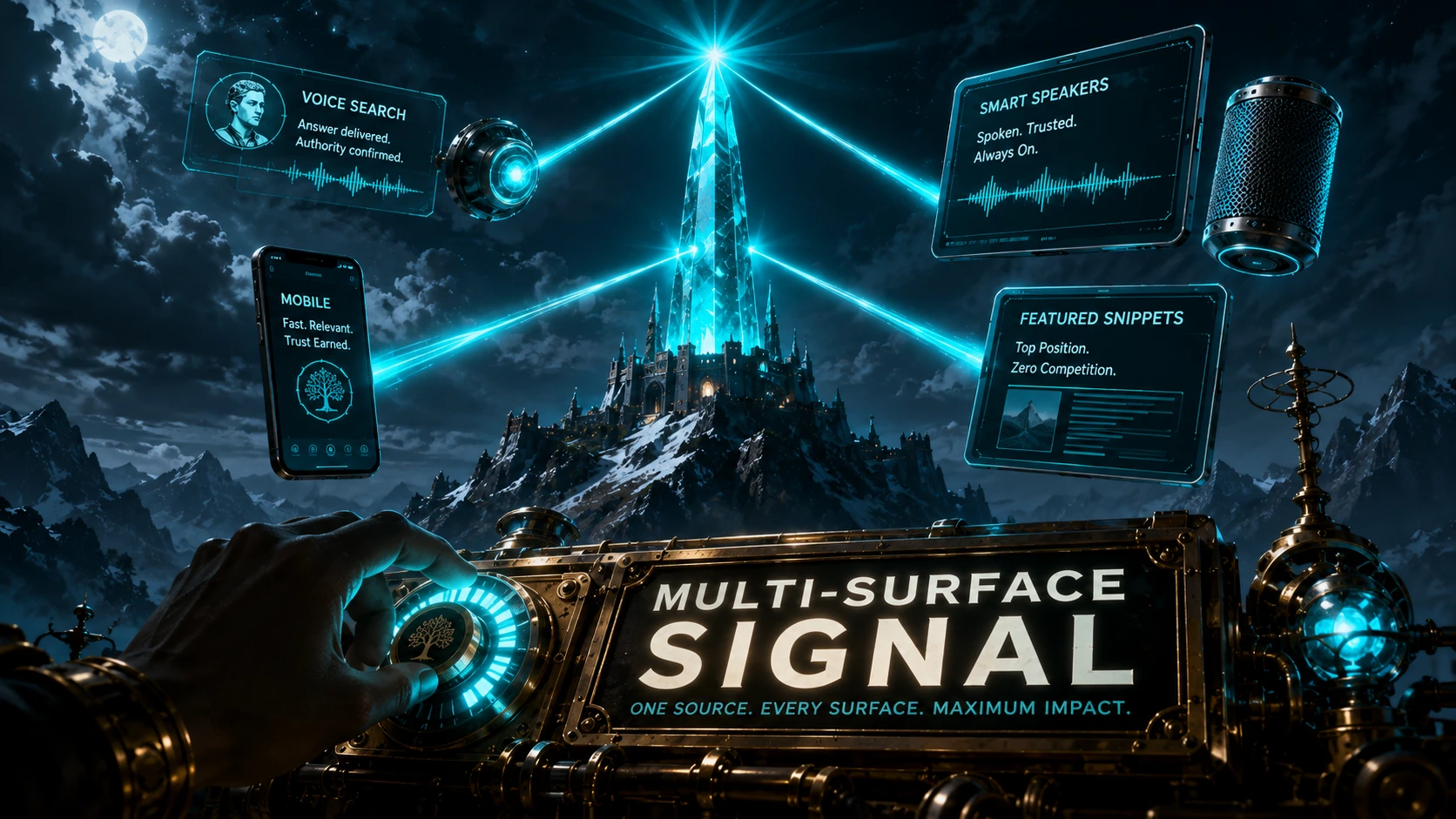
Surface-Neutrality: Designing for Extraction
Traditional web pages were designed to be “seen.” Modern search engine optimization requires pages that can be “heard” and “summarized.” A “Surface-Neutral” strategy means stripping away visual dependencies. Instead of writing “Look at the image below,” your text should describe the action so clearly that a voice assistant could guide a user through the process while their eyes are elsewhere [3].
By adopting this approach, you ensure your responsiveness signal remains high even on devices without a traditional display. This is the ultimate form of technology leverage—creating content once and having it serve the entire AI ecosystem.
Key takeaway: The ‘Surface-Neutral’ strategy ensures your expertise is equally extractable for a visual screen, a voice assistant, or an LLM summary.

The Machine-Readable Instruction Set
To scale your instructions effectively, you must speak the language of the bots. Implementing HowTo Schema [4] is like providing a “remote control” for your content. It tells the AI exactly where each step begins, what tools are required, and what the final result should look like. This level of technical clarity is what allows you to position your brand as a step-by-step authority in the knowledge graphs that power modern search.
Key takeaway: Structuring guides with explicit Step schema turns your business processes into machine-readable commands that AI agents can recommend.
Visual vs. Surface-Neutral Instructions
| Context | Poor Instruction (Visual-Only) | Superior Instruction (Surface-Neutral) |
|---|---|---|
| Buttons | ”Click the red icon at the bottom." | "Select the ‘Emergency Stop’ button located in the footer.” |
| Progress | ”See how the bar has changed?" | "Monitor the progress gauge until it reaches the 90% threshold.” |
| Placement | ”Put the item here." | "Place the sensor three inches from the central hub.” |
| Success | ”It should look like this image." | "The indicator light will pulse Teal once the connection is verified.” |
Building Trust with the Human Element
In an era of deepfakes and AI-generated noise, the “Human Element” is your most valuable trust signal. As your automated entities provide organization proof, your imagery should complement this by showing real-world application. Including human hands, profiles, or figures in your guides doesn’t just provide scale; it proves that your “journey” is led by people, not just algorithms.
Key takeaway: Incorporate a human element in your instructional visuals to build immediate trust and provide scale/perspective for the end-user.
Conclusion: Orchestrating the Universal Answer
The future of work is not about creating more pages—it is about creating the Universal Answer. When your instructional content is structured for any surface and anchored by the human element, you move from being a “website” to becoming a “utility.” This sets the foundation for your final step: connecting your automation for smarter authority.
As you broadcast your expertise, remember: the clearest signal is the one that can be followed through the dark, through the fog, and across any surface [5].